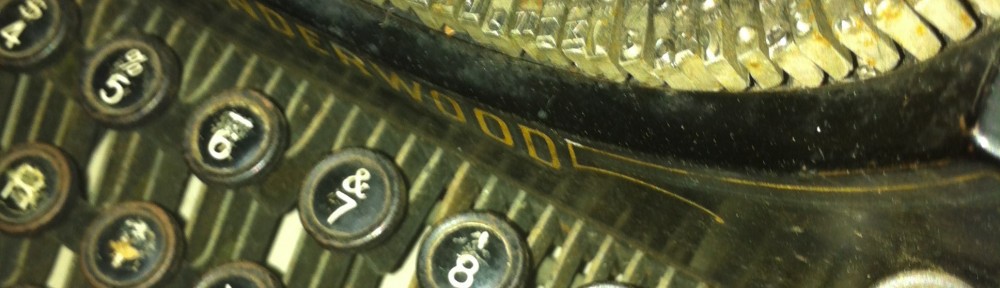
Congress will have input to any nuclear deal with Iran after the White House indicated it would accept bipartisan legislation which passed to the full Senate from the Foreign Relations Committee on Tuesday. The New York Times writes:
Republican opponents of the nuclear agreement on the committee sided with Mr. Obama’s strongest Democratic supporters in demanding a congressional role as international negotiators work to turn this month’s nuclear framework into a final deal by June 30. The bill would mandate that the administration send the text of a final accord, along with classified material, to Congress as soon as it it completed. It also halts any lifting of sanctions during a congressional review and culminates in a possible vote to allow or forbid the lifting of congressionally imposed sanctions in exchange for the dismantling of much of Iran’s nuclear infrastructure. It passed 19 to 0.
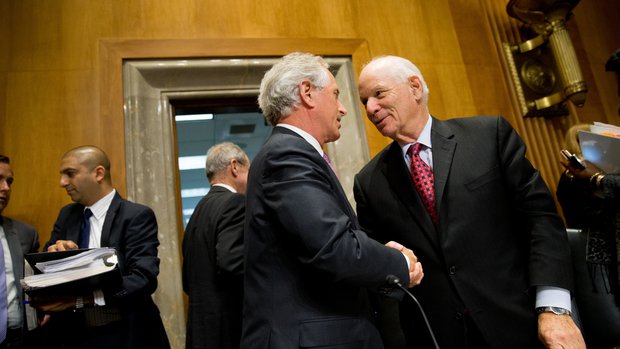 (image: AP/Union-Tribune San Diego)
Politico explains how Republican Bob Corker and Democrat Ben Cardin came up with Tuesday’s compromise, while Greg Sargent at the Washington Post explains why the new bill, which replaces the original Corker-Menendez bill, is better, but still poses a risk to reaching a final deal with Iran.
The problem isn’t necessarily that Congress could end up voting down a deal later. It’s perfectly possible that many Democrats who support Corker-Menendez could ultimately support a final deal. Indeed, that might be easier for them to do after they’ve proved their “toughness” by backing Corker-Menendez. Under this framework, if Congress disapproves of the final deal, restricting Obama’s authority to lift sanctions, and Obama vetoes that, but Congress fails to override that veto, the deal goes forward in the short term anyway. That’s because under this framework, not passing a restriction of Obama’s authority to lift the sanctions is the equivalent of approving that authority. It’s very hard to imagine Democrats — even ones who support Corker-Menendez — helping to override a veto and killing a final deal after it has been reached.
***
* WORLD * The White House announced that the US is to remove Cuba from the list of state sponsors of terrorism, an expected step in the normalization of relations between the two countries. Congress will have 45 days to consider the decision before it takes effect. Cuban officials welcomed the “fair” move.
Tensions again are rising between Britain and Russia after the RAF scrambled Typhoon jets to intercept Russian bombers flying near British airspace. The Independent also reports that Russian warships in the English Channel are heading for military exercises in the North Atlantic.
Officials from the Russian Defence Ministry’s were quoted by the Interfax news agency as saying the warships belonged to Russia’s Northern Fleet, which sparked controversy with a similar move last November.
According to the official, the ships were to pass through the Channel on their way to holding anti-aircraft and anti-submarine defence drills in the northern Atlantic.
One year after Boko Haram abducted nearly 300 Nigerian schoolgirls – of whom 219 are still missing – sparking the #BringBackOurGirls hashtag, a report from Amnesty International details the “horrifying scale” of the terrorist group’s activities since.
The Los Angeles Times reports: “Since 2013, Boko Haram has killed at least 6,800 people, mostly civilians,” the report says. “More than 1.2 million people were forced from their homes and hundreds of thousands of people have been made destitute.” Boko Haram carried out 46 bomb attacks between January 2014 and March 2015, killing at least 817 people, according to Amnesty International, which called for the group’s commanders to be brought to justice for crimes against humanity.
***
* POLITICS *
(FreeBeacon)
In an episode almost beyond parody, media swamped a small town in Iowa where Hillary Clinton held the first public event of her 2016 Presidential campaign. After manically chasing her SUV, nicknamed “Scooby”, as it arrived at a community college in Monticello, the press outnumbered locals as the candidate prepared for an intimate “listening” event with local students.
The actual “roundtable” when it came was something of a sterile anticlimax, with participants and their questions having been pre-screened. But beyond the expected re-hashing of themes from her announcement video, she did say one interesting thing – apparently committing to a constitutional amendment on campaign finance reform. The Washington Post reports:
“We need to fix our dysfunctional political system and get unaccountable money out of it once and for all — even if it takes a constitutional amendment,” Clinton said in opening remarks at a roundtable event with Kirkwood students and instructors.
The 2016 presidential election is expected to be the most expensive in U.S. history, with super PACs and campaigns likely to spend billions of dollars.
Clinton’s comments come as many of the Democratic Party’s biggest donors, as well as her super PAC allies, are gathering in San Francisco for a meeting of the Democracy Alliance.
Rick Newman at Yahoo Finance writes that the candidate “is bashing CEOs while taking their money” and lists some of the early top tier donors to her campaign.
But John Dickerson at Slate writes on “what Clinton has going for her that other candidates don’t”:
All campaigns and candidates require the manufacturing of authenticity. The best candidates manufacture it really well. As Ronald Reagan often said, being an actor was great training for the presidency. So Clinton was engaging in a familiar ritual by trying to set up a tableau that suggested she understood real people’s concerns. (In the television age, candidates since Eisenhower and Kennedy have used regular people in this way.)
But Clinton, despite the formality that seems to fit her titles as former senator and secretary of state, has something going for her that other politicians do not when it comes to these kinds of events. Though she is now encased in extraordinary privilege, which shields her from the normal abrasions of life that voters worry about, she has thought about family issues her entire life. So when one of the participants, a single mom, talked about how hard it was to attend community college, care for her three kids, and afford tuition and school materials, Clinton could refer to a scholarship she’d set up in Arkansas years ago for women in just that situation.
This may explain why, despite her celebrity, polls show that voters believe she is the candidate who understands their concerns the best.
At the New Yorker, Ian Crouch looks at why Kate McKinnon’s Hillary on SNL is more effective than that of the previous player, Amy Poehler.
Hillary was said to have admired Poehler’s impression. It’s unlikely that she, or her political handlers, will find much to like in McKinnon’s. Like Poehler, McKinnon satirizes Hillary’s frustrated will to power, but in her version Hillary seems to have spent the past eight years nursing that particular grudge to the point that it has grown into a fully formed split personality. McKinnon’s Hillary gapes and grimaces, contorting her face in an effort not merely to appear at ease and “relatable” but to keep the other Hillary—the spurned, bitter, and crazed version—from coming out.
On the GOP side, Gov Chris Christie was in New Hampshire
while also heading to the Granite State later this week is former New York Governor George Pataki…
So we got that going for us.
***
* BRITISH ELECTION *
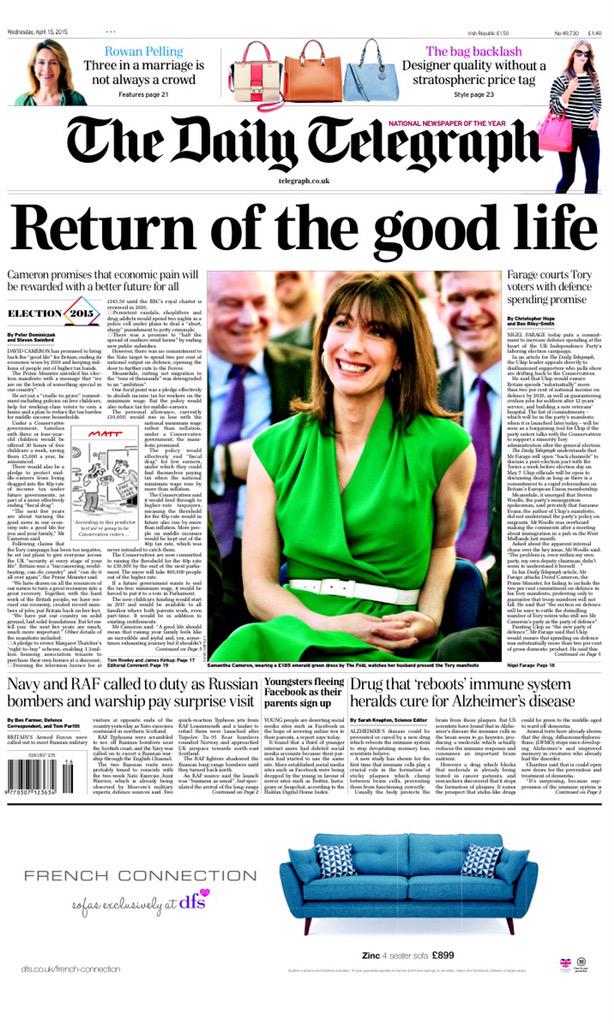
(Daily Telegraph/Tomorrow’s Papers Today)
The Conservatives launched their election manifesto, promising a “good life for all” with Prime Minister David Cameron saying he wanted “to finish the job” of rebuilding Britain on behalf of “working people”. The Guardian says the manifesto is a “false prospectus”.
Mr Cameron’s presentation was so set on being upbeat that it said much less about many mean-spirited commitments lurking in the manifesto itself. The continuing retreat on alternative energy, for instance – subsidies for onshore wind farms ended – got no mention. Nor did the nasty pledge for a further freeze in the BBC licence fee. Nor did the further dilution of any reform of the House of Lords. Nor did the snooper’s charter, which the Tories would reintroduce if they form the next government.
Mr Cameron said nothing, either, about the much tougher thresholds that will be required for union strike ballots; who is refighting the class war now? Nor did he dwell on the plan to abolish the Human Rights Act; he found time, however, to make a snide remark about civil liberties. The even more serious divisiveness of the manifesto’s plans on the United Kingdom, above all the commitment to set an English rate of income tax, was also unmentioned in the speech; once again, while professing undying commitment to the union, Mr Cameron is in fact pushing it to the edge of the abyss in another attempt to woo back Ukip voters.
The Greens also launched their manifesto – “spending on everything but time,” writes John Crace in The Guardian.
The Lib Dems launch their manifesto on Wednesday, claiming to be the only alternative to a “coalition of grievance” according to Nick Clegg.
Nate Silver talks to the FT’s Matt Garrahan about analyzing the UK election and how it differs from the US.
(Financial Times)
***
* BUSINESS * After a scrubbed launch yesterday, the SpaceX rocket took off successfully this afternoon, but “couldn’t reach its goal of safely landing the rocket’s first stage on a barge.”
The EU’s Competition Commissioner is expected on Wednesday to accuse Google of illegally abusing its dominance of the search market in Europe, the Financial Times reports.
Google confirmed the imminent charges in an internal email sent to staff on Tuesday. “We have a very strong case, with especially good arguments when it comes to better services for consumers and increased competition,” it said in the communication, a copy of which was obtained by the Financial Times.
Serving Google with a so-called statement of objections will be the opening salvo in one of the defining antitrust cases of the internet era. It could prove as epic as the decade-long battle with Microsoft that ultimately cost the company €2bn in fines.
PWC released its report on the ‘sharing economy’ concluding that it’s getting very big very fast.
Tuesday was Equal Pay Day. Meanwhile, the SEC has still to implement a rule first suggested in the 2010 Dodd-Frank law that would expose how wide the gap was between a company’s chief executive and its rank-and-file workers.
And Wednesday, of course, is Tax Day.
***
* MEDIA * Veteran anchor Tom Brokaw pushed back on a recent Vanity Fair piece suggesting he was trying to prevent Brian Williams from returning to NBC. Meanwhile, the network is expected to make a decision on Williams – what Brokaw called a “really really serious case” – by the beginning of next month. Brokaw also told his audience at the University of Chicago that arguing with Fox’s Bill O’Reilly was “just not worth it”.
(University of Chicago Institute of Politics)
After being ranked 199th of 200 jobs last year, newspaper reporter is now officially the “worst job of 2015” Romenesko reports. Sigh.
Headline of the Day:
***
* CULTURE * R&B singer Percy Sledge, whose 1966 hit “When A Man Loves A Woman” sold a million copies and was Atlantic Records’ first Gold Record, died aged 74.
Tuesday was the anniversary of the sinking of the Titanic in 1912. Follow the voyage in real time Tweets here.
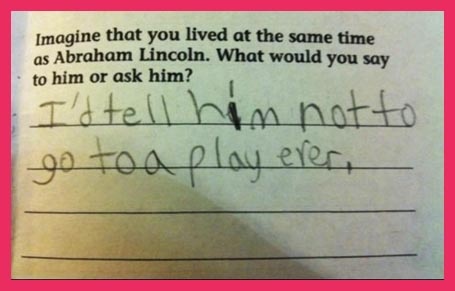
It was also the 150th anniversary of the assassination of Abraham Lincoln.
https://twitter.com/AP_Interactive/status/587985073435189249
***
* SPORTS * In the first-legs of the first two Uefa Champions League quarter-finals on Tuesday, Juventus beat Monaco 1-0, while in the Madrid derby, Atletico and Real played out a fiery goalless draw. In the opening salvoes of the other two ties on Wednesday, Paris St Germain hosts Barcelona and FC Porto welcomes Bayern Munich.
Wednesday marks 26 years since the Hillsborough disaster claimed the lives of 96 Liverpool supporters at the FA Cup Semi-Final. Liverpool will fall silent for a minute’s remembrance at 3.06pm.
***
 The Overnight Note