
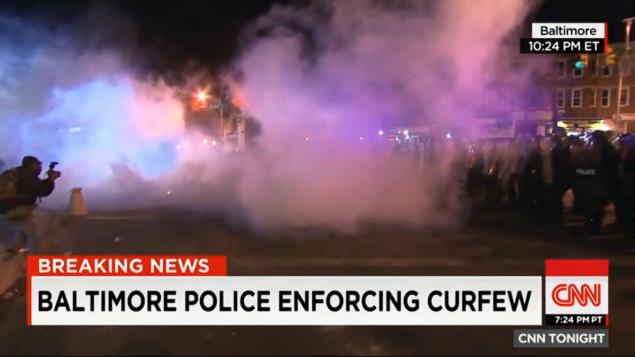
 (image: CNN/New York Daily News)
Police and National Guard troops in Baltimore enforced the first night of a week-long 10pm curfew, dispersing what appeared to be a relatively small crowd and quieting some minor disturbances within roughly an hour. By midnight the city was “safe” and “stable,” the city’s Police Commissioner told a press conference.
* Follow WBAL’s Live Wire updates here.
* Follow live updates from the Baltimore Sun here.
Elsewhere, hundreds of people gathered in Chicago in a peaceful protest against police violence, although two people were reportedly shot during a protest in Ferguson, Missouri.
Earlier, footage was widely circulated of one Baltimore mother who didn’t take kindly to her son’s participation in Monday’s protests.
(ABC2 News WMAR)
Events of the past few days have focused attention on media coverage of the situation. As The Huffington Post points out:
Protests actually began in Baltimore the day before [Freddie] Gray’s death and continued for five days without violence. Over the weekend, some protesters clashed with police, although demonstrations remained largely nonviolent. Police have still not revealed details about Gray’s arrest or the circumstances of his fatal injuries.
The HuffPo reports how a protester challenged MSNBC’s Thomas Roberts on-air: “My question to you is, when we were out here protesting all last week for six days straight peacefully, there were no news cameras, there were no helicopters, there was no riot gear, and nobody heard us,” she said. “So now that we’ve burned down buildings and set businesses on fire and looted buildings, now all of the sudden everybody wants to hear us.”
Justin Peters writes at Slate how CNN’s coverage has been “shallow and sensationalistic.”
CNN, like all televised media, specializes in nearsighted news, favoring big, easily apprehensible images and storylines. The limitations of the format often demand one central visual narrative, to which the reporting and commentary act in service. Burning cars and looted buildings are big, striking images that play well on television, but they too often end up reducing complicated issues to stories about property damage. If it sometimes seemed Monday as if CNN expected Baltimore to burn, that’s understandable: CNN mostly just sees the things that are already on fire.
But The Washington Post‘s Hank Stuever writes “Is CNN as bad as everyone thinks it is? Yes.. and no.”
The strongest visual will always win. CNN would be shirking its duty if it declined to show such events to appease some nobler effort to accentuate the positive, which, in this case, included the many people who chose peaceful protest. TV news frequently finds itself explaining why non-burning buildings and people standing still (or staying home) don’t make the cut.
But viewers — from President Obama down to the rest of us — also recognize the corrosive effects of repeat footage of looting and fires. When CNN fixates on a burning car as its primary visual for 45 minutes, or when it appears to treat the loss of one CVS drugstore as a bigger tragedy than the death of a person in police custody, viewers pick up on that.
One element of instant coverage that was widely welcomed and applauded was the live-stream work via Periscope by The Guardian‘s Paul Lewis; covered in a really interesting piece by Jonathan Albright, “The Revolution Will Not Be…Periscoped?” Also worth a look are the reactions here at Streamalism. Lewis himself wrestles with the openness of the platform as it’s running here:
https://twitter.com/PaulLewis/status/593211222264324097
News that Wednesday’s Orioles-White Sox game would be played behind closed doors and the team’s next home series against Tampa Bay would be moved to Florida, led Dave Zirin at The Nation to write:
This decision was clearly made on public safety grounds, but there will be something haunted about the visuals that will ensue. Whenever the Orioles play away from home, many of the surrounding businesses resemble a ghost town, revealing the instability of sports as an economic stimulus. Now the inside will be a ghost town. No screaming. No cheering: as quiet as Freddie Gray, and as searing as the promise of a stadium once built with the prospect of jobs and renewal, that has become a hub of police-protected boorish decadence and poverty jobs. It’s a place that may have acted as symbolic gasoline on the fires in Baltimore but it is not a Baltimore story. It’s the United States in 2015, and it’s a far cry from a game.
Zirin references the Twitter stream of Orioles’ executive John Angelos and his comments on the situation – they’re worth reading in their entirety.
As the city waits, uncertainly, for the next countdown to the next curfew, the Baltimore Symphony Orchestra announced it would perform a free outdoor concert “in support of our community” on Wednesday at lunchtime, ending the announcement with Leonard Bernstein’s famous quote:
“This will be our reply to violence: to make music more intensely, more beautifully, more devotedly than ever before.”
***
* WORLD * Australia withdrew its ambassador to Indonesia amid outcry following the execution of eight people, including two Australians, part of the so-called Bali Nine.
The death toll from the weekend’s earthquake in Nepal passed 5,000, with more than a million people urgently needing food aid, as supplies finally start to reach remote villages.
The Saudi King appointed a new Crown Prince.
***
* POLITICS * The Senate rejected moves to require any nuclear agreement with Iran to be considered an international treaty, which would have forced any deal to be ratified by two-thirds of the Senate’s 100 members.
Independent Vermont Senator Bernie Sanders is to enter the race for the Democratic Presidential nomination on Thursday, Vermont Public Radio reports. Sanders held a town hall meeting on, yes, Periscope.
Following oral arguments on Tuesday at the Supreme Court over the issue of marriage equality, there will be much speculation over how the justices are leaning until they rule in June. The Baltimore Sun writes in an editorial:
The present circumstances, this mishmash of marriage law, is neither tenable nor fair. What Mr. Obergefell and others seek is equal treatment under the law. Should that be denied until public opinion reaches 75 percent approval? Eighty percent? It’s time for the court to recognize that the Constitution’s guarantees of equality do truly extend to all.
***
* BRITISH ELECTION * An interview between Labour leader Ed Miliband and comedian Russell Brand is set to be posted on You Tube on Wednesday. The BBC reported that Miliband said he agreed to the interview “to liven up the election race,” while Prime Minister David Cameron had said he “did not have time to hang out” with Brand.
The Daily Star seems pretty confident it knows what was on the agenda.

Meanwhile, Ed Balls celebrated Ed Balls Day by manually retweeting himself.
***
* MEDIA * Wired magazine looks at How the NYT is sparking the VR journalism revolution. Angela Watercutter writes:
A lot of the questions about the importance of VR for journalism go back to empathy—the current buzzword in VR filmmaking. Taking a page from Roger Ebert’s assertion that a movie is an “empathy machine,” people excited about VR’s storytelling potential like to point out that nothing will make a person more empathetic to a protagonist than virtually living in their world. So when that protagonist is actually a resident of a war-torn country, say, or protester in the streets, that potential for empathy is quite sizable.
***
* SPORTS * The FA Cup, football’s oldest domestic knockout cup competition, is to be renamed the Emirates FA Cup as part of a £30m sponsorship deal. The deal replaces a three-year arrangement with Budweiser – but which did not formally require the re-naming.
As the current football season reaches it final stages, promotion and relegation issues are being resolved. Wigan, who won the FA Cup just two seasons ago, will next year play in the third tier of English football, after being relegated along with Millwall on Tuesday night.
***
* CULTURE * Jack Ely, co-founder of The Kingsmen and famously indistinct vocalist on their biggest hit – America’s favorite college party tune “Louie Louie” – died aged 71.
Ely, the only band member who knew all the words to Richard Berry‘s calypso-meets-R&B song that day had just had his braces tightened and couldn’t enunciate clearly. The producer moved the microphone away from him, capturing the music but muffling the words.
Ely’s incomprehensible vocal track famously spawned an FBI investigation into whether the Portland-bred garage band violated federal obscenity laws with the lyrics of the hit, which was sweeping up the charts worldwide.
(YouTube/HollywoodAGoGo)
 The Overnight Note