As the nation heads into the July 4th holiday weekend, its collective nerves were rattled after a massive mobilization by law enforcement in response to a situation at the Navy Yard in Washington DC, with initial reports of an “active shooter.”
Thankfully, there was no repeat of the deadly rampage in 2013 where a lone gunman killed 12 people. The Washington Post reports that the response to that incident helped guide training for a possible repeat, and shaped how the reaction by law enforcement unfolded on Thursday.
After the area had been on lockdown under a ‘shelter in place’ order for several hours, officials said they had found no evidence of a shooter, of any shots fired or of anyone being injured.
Was it a deliberate hoax? (police say no). A tactical distraction? (they likely wouldn’t say if they thought so). Or just a case where confusion is amplified through an overactive media?
Police later said the incident began when an employee “called from inside a Navy Yard building to report that she might have heard sounds of gunshots.” The Washington Post‘s Erik Wemple tries to look at the source of some of the early confusion as it was relayed via television.
Dylan Byers at Politico did likewise, noting that Fox News had walked back its initial report of a shooter, with host Bill Hemmer saying on-air:
“Breaking news now on a story we’re frankly still trying to figure out. Washington Navy Yard had been on lockdown early reports of an active shooter now there are reports that perhaps this was nothing, but we wait for the moment. A huge police presence flooding that scene, a scene where a massacre took place nearly two years ago so be patient with us as we work this out,” he said.
The Washington Post’s Paul Farhi writes that the incident showed how “news travels fast, but rumors move faster.” He says:
Facts are often the first casualty when news breaks. The confusion and speed of onrushing events can crimp the accuracy of the who, what and when of a story. But some news reports of a shooting at Washington’s Navy Yard on Thursday didn’t just blow the details. In a few cases, reporters got the whole story wrong.
The reaction of media – social and mainstream – to Thursday’s incident, with the intimidating visuals of the scale of the authorities’ response, together with a series of broader high-level national warnings, helped drive a narrative through the day’s news cycle that likely couldn’t help but have a negative effect on a national psyche that’s already halfway to the beach holding a hot dog.
USA Today reported that
Federal authorities have warned local law enforcement officials across the country about a heightened concern involving possible terror attacks targeting the July 4th holiday, a U.S. law enforcement official said.
While the Boston Globe reported that former CIA deputy director Michael Morrell had told CBS News this week about a heightened alert level and that that he “wouldn’t be surprised if we’re sitting here a week from today talking about an attack” in the U.S. over July 4th weekend.
(CBS News)
and finally …
***
* POLITICS * Former Virginia Sen Jim Webb announced that he was formally seeking the Democratic Presidential nomination. That’s the Democratic nomination. He becomes the fourth official candidate to challenge front-runner Hillary Clinton.
Beth Ethier writes at Slate:
It’s not clear what Webb’s ultimate goal is, assuming he is realistic about his chances of getting onto the Democratic ticket. He could be angling to be Hillary’s VP pick as a moderate whose military service could help her win over less-liberal swing voters, or hoping to bring attention to the veterans’ issues he cares about, especially PTSD treatment. Webb’s never seemed like an enthusiastic participant in D.C. politics, having left the Senate after only one term.
On the GOP side, Wisconsin Gov Scott Walker is set to announce his candidacy on July 13, Politico reported.
But at a speech in La Crosse on the economy, the President jabbed back..
Likening Mr. Walker and the “bus full” of Republican candidates to an “Uncle Harry” at Thanksgiving dinner who says something that makes no sense.
“You still love him,” the president said. “He’s still a member of your family. Right? But you’ve got to correct him. You don’t want to put him in charge of stuff.”
***
* BUSINESS * Reuters reports that Aetna is nearing an agreement to buy Humana, with a $34billion deal possibly being announced on Friday.
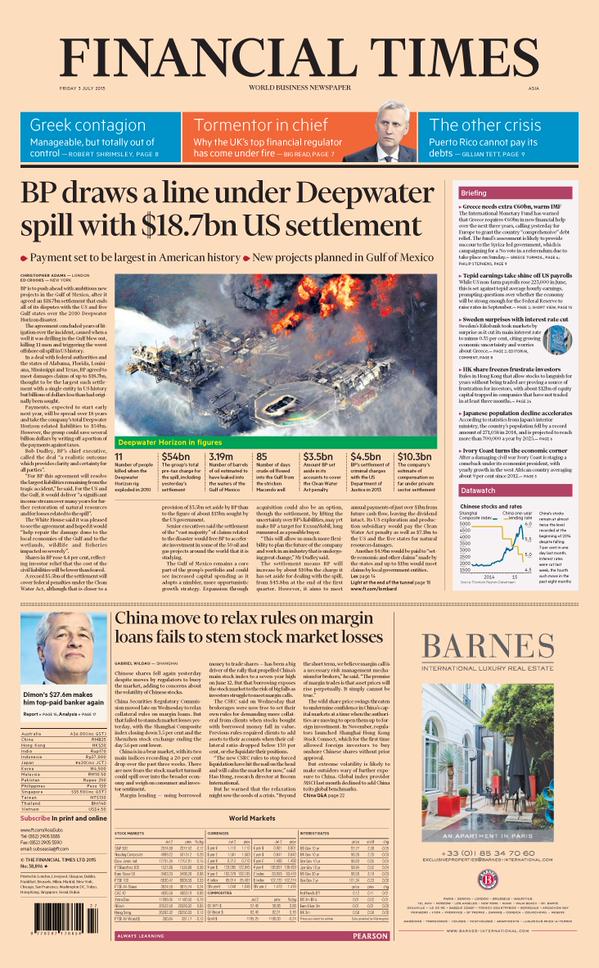
Oil giant BP reached a settlement with the US Department of Justice over damages from the 2010 Deepwater Horizon accident and oil spill in the Gulf of Mexico. If the $18.7bn total amount is finalized, BP will pay claimants over the next 18 years.
It would be the largest settlement paid by a single company in US history. The Economist explains why it could prove more costly than just the headline numbers.
BP has other troubles, however, that are only partly the result of the tragedy and its aftermath. The company has slimmed down since the spill, selling assets worth over $40 billion. But now it faces a sustained period of low oil prices and the possible unwanted attentions of firms that might see BP as an even more alluring takeover target, now that it is smaller, weaker and has dealt with most of its spill claims.
***
* WORLD * As Greece prepares for its referendum on Sunday over whether to accept the Eurozone creditors’ bailout plan, the Wall Street Journal reports that the IMF had “raised the stakes” by warning that
Greece’s economic situation has considerably worsened thanks to the escalating conflict with its creditors, and any new rescue deal that involves the IMF would require greater financial generosity from Europe than eurozone leaders have been willing to countenance so far.
The Economist writes in its latest issue that however the current crisis resolves itself, Europe will be changed for ever.

Look beyond Greece, and the threat of further conflict within the euro is all but inevitable. Although Greece’s departure would prove the euro is not irrevocable, nobody would know what rule-breaking would lead to expulsion. Nor would it resolve the inevitable polarisation of debtor and creditor governments in bail-outs. If the single currency does not face up to the need for reform, then this crisis or the next will witness more Greeces, more blunders and more dismal weeks. In time, that will wreck the euro and the EU itself.
In what seems to be almost a July 4th weekend tradition, German officials summoned the US ambassador to account for reports of US surveillance on top members of the government. The New York Times reports that this year’s situation “signaled another recent low in German-American relations. And it showed how difficult it has proved to be for the two close allies to shake off years of scandal over snooping.”
***
* CULTURE * Prince announced he was pulling his catalog off some online services including Spotify. But CNN reports that “if fans want to listen to Prince digitally they can head over to TIDAL, the Jay Z-owned music streaming service, which still has the artist’s songs and albums in its library.” The move didn’t stop him releasing a new track, however.
***
* SPORTS *
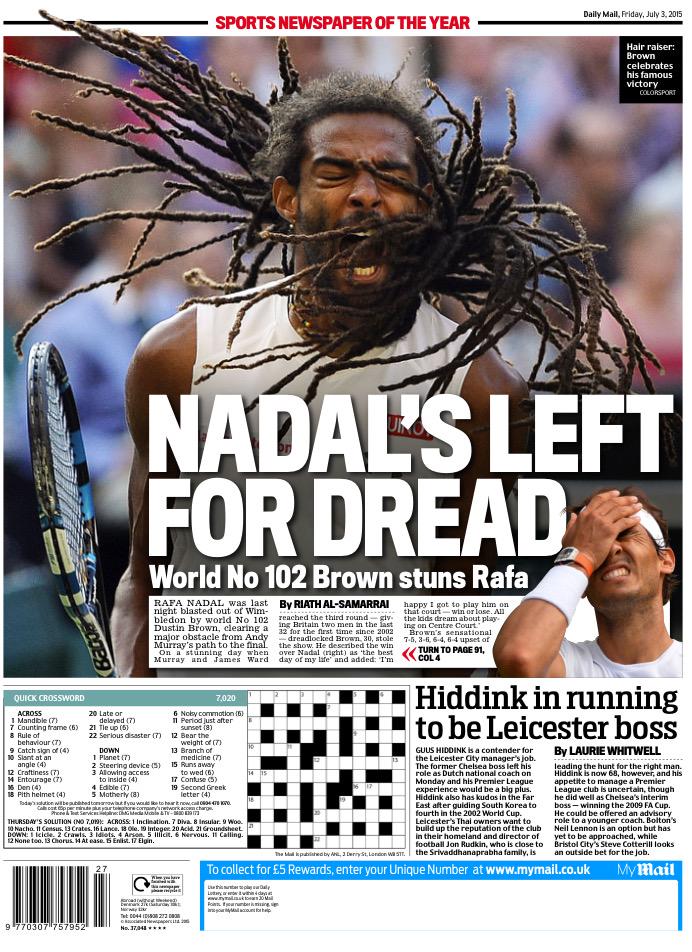
Finally, qualifier Dustin Brown defeated Rafael Nadal at Wimbledon causing something of a seismic upset in the tennis world and prompting this Daily Mail back page, featuring one of the amazing pictures from the day.
The St Louis Cardinals fired their Director of Scouting as investigations continue into the hacking of computer systems owned by the Houston Astros.
US authorities investigating allegations of corruptions at World Soccer’s governing body FIFA issued an extradition request for seven top executives, according to Swiss officials.
The AP writes that:
The seven will be heard by Zurich cantonal (State) police and granted a 14-day period to respond to federal officials about the extradition request, the Swiss justice ministry said.
Swiss justice officials will then rule “within a few weeks” on whether to extradite them. That ruling can be appealed to Switzerland’s top criminal court and supreme court.
Meanwhile, France24 reported that a former FIFA official had said that the organization “will be forced to make certain basic reforms or it will lose big sponsors.”
 The Overnight Note